
Recap: Build More Homes and New Towns Summit 2026


This year’s Build More Homes and New Towns Summit offered invaluable insight into the key issues shaping housing delivery.
From Simon Century’s views on funding and Brian Berry’s warnings over the skills crisis, to Joanna Averley’s planning updates and Chris Curtis MP’s refreshing political honesty, the day brought together many of the defining conversations set to shape the sector over the next twelve months.

What did we learn?
1. The money is available - but the sector has to move
Simon Century of Homes England and the National Housing Bank set the tone: £39bn social and affordable, £2.5bn low-interest lending, £2bn National Housing Delivery Fund consolidating 17 funding streams, a new Aviva JV on land and planning. This is deployed capital looking for a pipeline. The test, as multiple speakers noted, is whether the sector can mobilise quickly enough to absorb it.
2. Tom Copley: London's focus has shifted
The Deputy Mayor was clear that the GLA’s emergency package - including the 20% affordable housing threshold, increased Mayoral powers and extended deadlines - was shaped by sector feedback and has been well received. He pointed to the draft London Plan, due in June, as the next key milestone: a slimmed-down plan designed to bring greater clarity to the system and help accelerate delivery.
3. Procurement is broken - but fixable
With 83% of the sector identifying procurement as a barrier, discussion focused on how the 2023 Procurement Act has introduced additional complexity and transparency requirements that risk putting strong developers off public sector work. But the case was also made for procurement as an enabler. Mark Robinson (Scape) argued it can be a silver bullet when used to foster collaboration, while Joanne Drew (Enfield) showed what that looks like in practice through a mission-based, data-driven approach delivered end-to-end in four to five months. Claire Bennie and Natalie Elphicke Ross identified the deeper challenge as a lack of trust and fear of challenge - and the solution: embedding design quality and true collaboration into the brief from day one.
4. Planning reform is showing up in the data and the numbers tell an encouraging story
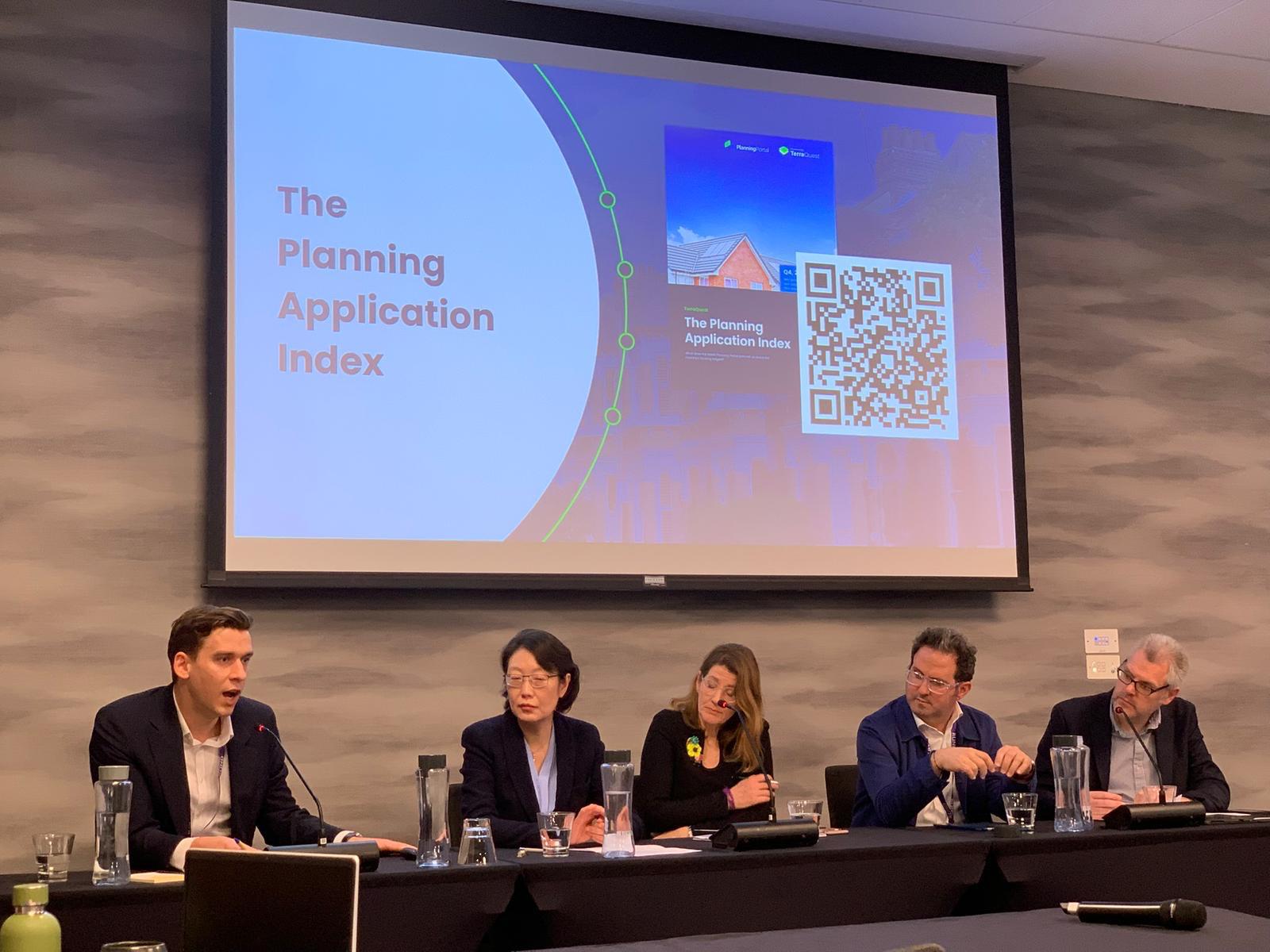
The planning session, fantastically chaired by Martin Hilditch, brought together a strong mix of perspectives. Joanna Averley positioned planning as an enabler, supported by key reform and digital transformation. Prof. Samer Bagaeen pointed to the RTPI London’s NPPF response and the ongoing need for stronger resourcing and better coordination across infrastructure, while Wei Yang OBE reinforced the importance of greater system connectivity and data to support more effective decision-making.
TerraQuest’s Daniel Williams brought invaluable market insight through Planning Portal submission data, showing that the activity of the past year is genuinely beginning to come through. Affordable housing submissions are increasing, while policy reforms - including grey belt, housing targets and brownfield measures - are driving higher application volumes. Submissions are up across the board.
The caveat, and it is an important one, is that higher submission volumes have not yet translated into delivery at the same pace. Viability remains the constraint. The planning system is doing more of what it is supposed to do; processing applications, responding to reform signals and generating pipeline, but the gap between permission and spade in the ground remains stubbornly wide.
The collective message from the session was clear: the reforms are real, the data is moving in the right direction, and the tools exist. What the sector now needs is the resourcing, coordination, confidence and viability solutions to turn that pipeline into homes.
5. New towns: viability, leadership, and who draws the first line
Chris Curtis MP (Milton Keynes North) was direct: the previous government was too concerned with political optics to deliver the homes required. New town structures, he argued, change that - making it easier to build at pace and bring communities with you. But if the instinct is to lean into NIMBY resistance and find ways to say no, things do not get done, and communities push back even harder against local government.
On viability, he argued it requires carefully bringing down land values through the tax system, as well as reducing the cost of building, noting that over-regulation has made new homes very expensive to deliver. Annalie Riches (Mikhail Riches) raised the architect dimension: where communities are not given enough confidence in how development is happening, concerns grow around transport and school places. She also argued architects were not brought in early enough to the new towns task force - a structural mistake that needs correcting.
Olaide Oboh (Socius) brought a more visionary framing through the idea of “good growth” - knowing the community and building places that meet people’s needs.

6. Collaboration is on the agenda - but needs to move from intention to action
The closing plenary brought together Jonathan Corris, Elizabeth Froude, Eddie Hughes, Peter Murray OBE, Alexandra Notay Hon MRTPI, and Justin Young for one of the day's most wide-ranging discussions. The consensus: collaboration is talked about more than it is practised. The ambition is there across the sector, but translating it into genuine joint working - between local authorities, developers, investors, and government - remains the defining challenge. The frameworks exist. The willingness exists. What is needed now is the structural commitment to make it real.
7. MMC: the perception problem is as real as the practical one
Offsite construction continues to grapple with two parallel challenges: a lack of standardisation across the UK, which makes procurement and financing more complex, and a perception problem that limits confidence among clients, lenders and communities. Yet professionals still acknowledge that the opportunity MMC represents for delivery at scale and pace is too significant to leave on the table.

8. The talent and confidence question: how do we make housing a career of choice?
Underpinning much of the day’s discussion was a question the sector has not yet answered convincingly: how do we attract the talent, investment and confidence that sustained delivery requires? The closing panel was direct - this will require clearer signals from government, greater certainty in the policy and funding environment, and a far stronger narrative around housing as a place to build a long-term career. Construction, planning, development and design were positioned as careers with genuine prospects, particularly as AI changes the nature of work in other sectors.
9. The challenge: 1976 is too long ago
The fact that housing targets were last met in 1976 was a stark reminder of just how much still needs to change. Kunle Barker opened the day with the depth of the housing crisis in stark statistical terms - 200,000 homeless people and 100,000 children in temporary accommodation. The sector has the tools, the funding, and increasingly the political backing. What it needs now is the collective will to stop talking about collaboration and start practising it; to move from conference ambition to homes on the ground; and to build not just houses, but the careers, supply chains and communities that make delivery sustainable for the long term.


