
Q4 2025: 2025 sees highest level of new home applications this decade
.jpg)

The number of new homes applied for in England reached a decade high in Q4 2025, cementing 2025 as the strongest year for new home applications since 2020, according to the latest data from TerraQuest – signalling renewed confidence among developers.
Figures analysed in the latest edition of the Planning Application Index show planning permission was sought for 335,387 new housing units throughout 2025, which is more than 120,000 units above 2024 levels. The rate of growth gathered pace as the year progressed, with the second half of 2025 outperforming the first by nearly 72,000 units, an increase of approximately 51%.
.jpg)
A decade high for new housing applications
The Q4 surge pushed the total number of new homes applied for in England to a decade high, underlining a marked shift in momentum across the sector. Taken as a whole, 2025 stands out as the strongest year for new home applications since 2020.
This sharp uplift – more than 120,000 additional units compared to 2024 – points to renewed confidence among the sector, with activity accelerating significantly in the latter half of the year.
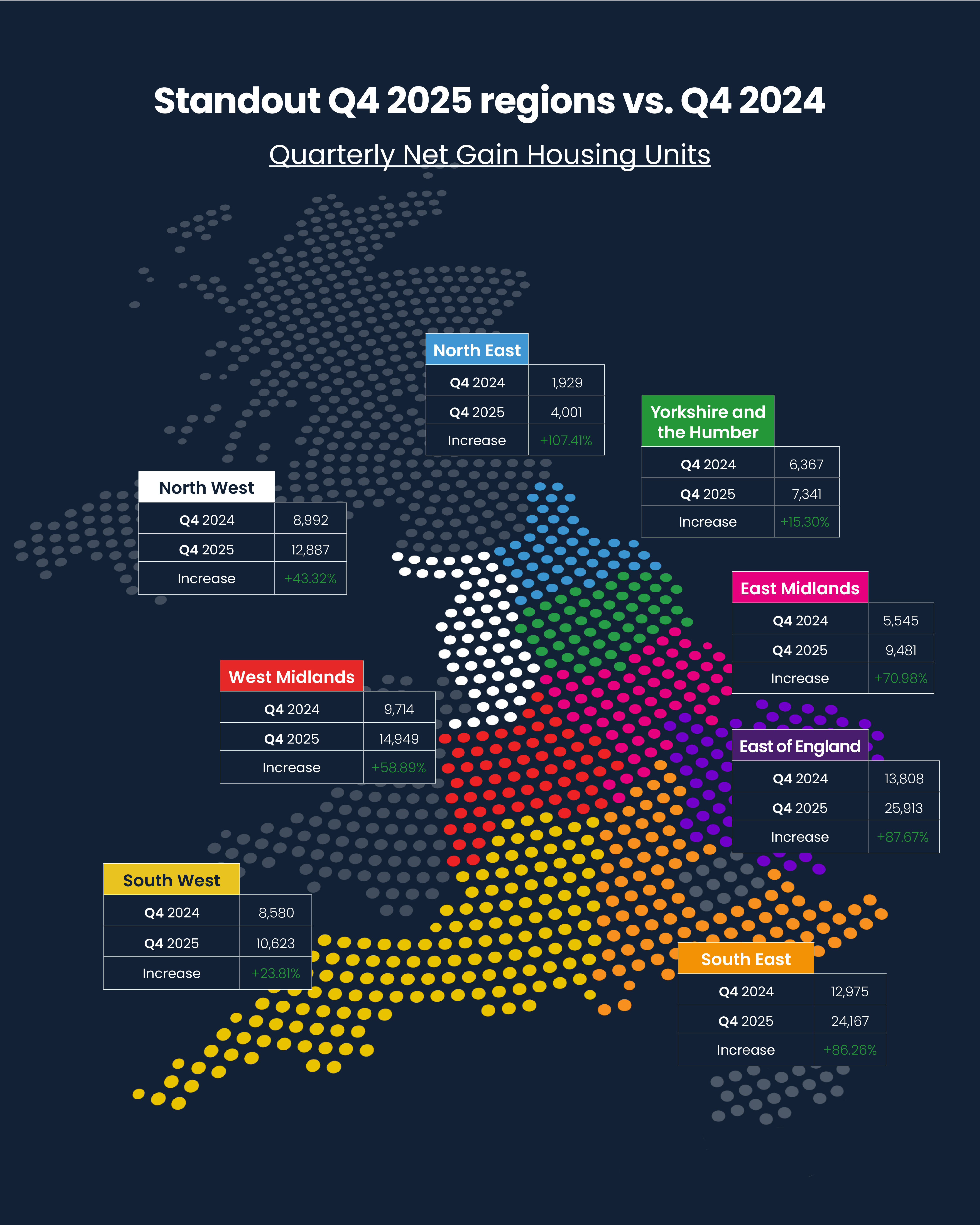
Affordable housing reaches five-year peak
Notably, applications for affordable housing also reached a five-year quarterly peak in Q4 2025, with 2025 overall recording the highest annual total for affordable housing in the last five years.
.jpg)
What the data tells us about developer intent
Planning Portal, operated by TerraQuest, is the national platform through which roughly 95% of planning applications in England are submitted. As such, the Index data provides the clearest early indicator of developer intent across the country.
TerraQuest’s figures demonstrate increased levels of developer intent, with planning submissions now tracking close to a level consistent with national housing ambitions.
However, the Q4 2025 report also notes high rates of attrition found later in the housebuilding process. While submission volumes have risen sharply, many schemes are stalled before completion, often due to viability pressures, infrastructure constraints or shifting economic conditions.
The latest Planning Application Index therefore paints a picture of renewed momentum at the front end of the pipeline – but also highlights the structural challenges that must be addressed if planning ambition is to translate into completed homes at scale.

Industry reaction
Geoff Keal, TerraQuest CEO:
“Housing submissions are returning to levels not seen for several years, which is a genuinely encouraging sign that confidence is rebuilding across the sector.
“But intent alone isn’t enough - the focus must now be on ensuring viable sites can move from application through to construction, so this renewed momentum results in homes being built.”
Brian Berry, Chief Executive of the Federation of Master Builders
"The rising number of planning applications for new build units is positive, it clearly shows a level of trust in the Government's plans for new housing. FMB data has shown confidence among SMEs is on the rise for 2026 - so clearly a government that is pro-building can make a difference, even if we don't fully know the impact of the changes to the planning system.”
“However, despite a rise in applications, the attrition rate from applications to actual new homes is high, so we probably won't see over 300,000 homes being built this year. The Government’s ambition to build 1.5 million new homes remains a deeply ambitious stretch target. SME housebuilders are still struggling to get homes built as evidenced by the long-term decline in the percentage of all new homes built by SMEs – now under 10%.”
“Until local house builders can be reinvigorated, the UK will remain overly reliant on large scale strategic sites for new home delivery and that's not necessarily what the public want or what's best for local communities."
Samuel Stafford MRPPI, Managing Director at the Land, Planning and Development Federation

“The Government’s recent housebuilding record has come under criticism, but current delivery levels cannot be viewed in isolation. While demand is closely linked to economic confidence, which is something government policy can certainly influence, the number of homes being completed today also reflects the legacy of regressive supply-side decisions taken by the previous administration.
“These figures show that, particularly outside London, the development industry is responding positively to this government’s more progressive supply-side reforms, such as support for development on Grey Belt land.
“The priority now must be to accelerate the approval of these applications, so that a strong pipeline of deliverable permissions can be established and the industry can move quickly from consent to construction.”


