
Q2 Planning Application Index 2026


Q2 2026: Housebuilding plans continue surge, but project starts fall
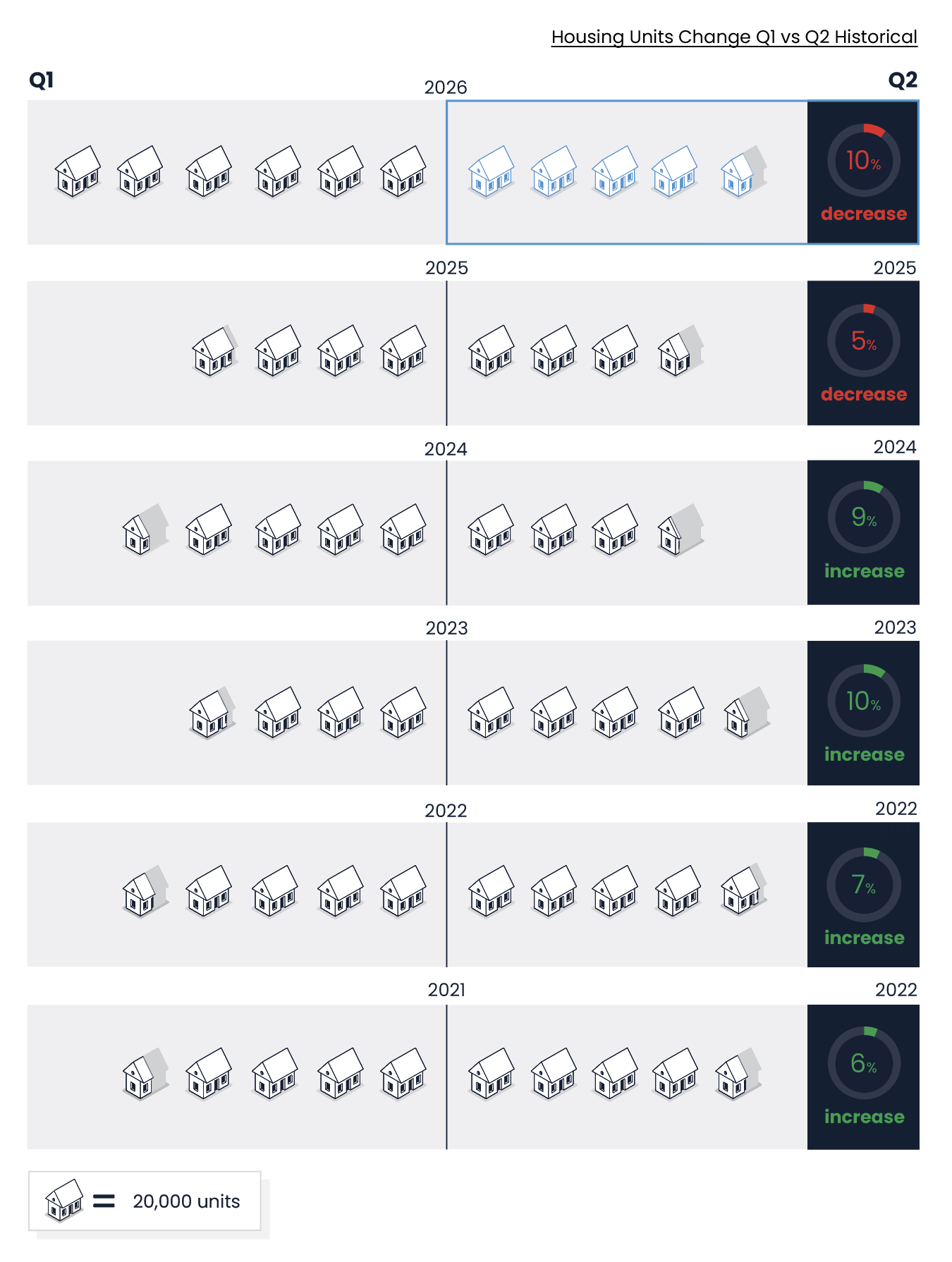
According to the latest data from national Planning Portal operator TerraQuest, 2026 was the first time net gain housing unit submissions exceeded 400,000 in any 12-month period since 2022.
Figures analysed in the latest edition of the Planning Application Index show the first half of 2026 recorded 189,520 housing unit submissions across England, including London, making it the strongest H1 of any year since the beginning of the current decade.
Yet the most recent ONS statistics on housing starts show just 150,000 in 2025 as a whole, suggest intent far outpaces delivery.
Social and affordable
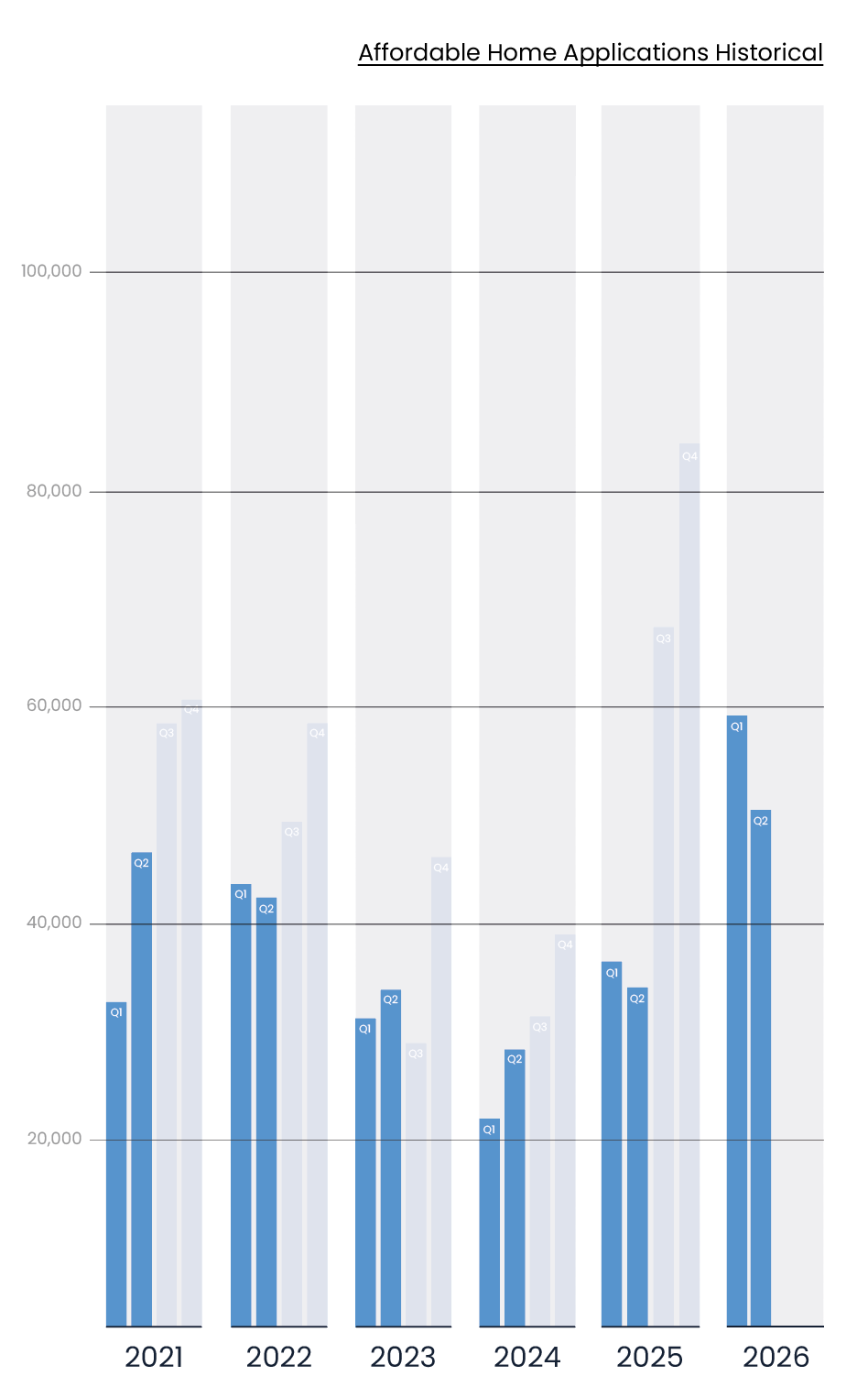
While affordable housing applications fell between Q1 and Q2, Q2 2026 still recorded 5,053 applications, making it the strongest second quarter for this housing type since the beginning of the decade. The increased level of intent paints a positive picture for the future pipeline of social and affordable housing.
Geoff Keal said: “The growth in social and affordable applications, which outpace the growth in applications for market homes, may well reflect additional funding for the sector outlined in recent budgets.
“While not immune to the delivery challenges seen across other parts of sector, public funding will, to an extent, insulate these plans from the fragility of the development pipeline. Ministers will hope that a resurgence in social housing can play a significant role in maximising the number of new homes delivered by 2029.”
Units per application
The average number of new homes included in a planning application has nearly doubled from 6.8 in Q1 2024 to 12.9 in Q2 2026, having peaked at 14.4 in Q4 2025.
Geoff Keal said: “This increase in development size has potentially significant implications for delivery. The larger a scheme is, the more prospective new homes are lost if that scheme fails. The risk profile of the development pipeline therefore changes as site sizes rise.
“It is possible that this figure reflects the new grey belt designation that makes planning permission for development on existing green belt land easier, along with other measures introduced to encourage the delivery of large-scale housing schemes.
At the same time, urban brownfield sites can often be significantly more challenging to bring forward viably. They typically cannot accommodate the scale of new homes required to align with the delivery models of larger housebuilders. Taken together, these factors may help explain the clear trend we are seeing towards larger-scale housing schemes coming forward for planning approval.”
Industry Reaction
Geoff Keal, CEO of TerraQuest and Planning Portal

“The gap between developer intent and on-the-ground delivery is continuing to grow. It creates a risk that applications will simply add to the ‘missing city’ of hundreds of thousands of new homes that have been applied for but never built.
“The trend points towards fragility in the development pipeline, with multiple considerations having to align for any given project to be viable. Economic confidence, local demand, willing lenders, transport infrastructure and connections to utilities are all necessary for the delivery of a given site. If any one of these is missing, that project is likely to stall.
“Nevertheless, the signal of intent continues to be robust, which suggests developers are increasingly optimistic that they can progress projects through to starts and completions. We shall see over the coming months whether that confidence is well founded.”
Tony Mulhall, Senior Specialist, RICS

“It is impressive to see the increase in planning applications up to mid 2026.
Broadly this is likely to reflect the reduction in so called ‘planning risk’ as a result of the pro-housing development reforms introduced by the new Labour government through the National Planning Policy Framework 2024 – in other words, a sector gearing up for development.
However, the lack of housebuilding evident in the data reflects the evaporation of the business case for development, an equally important part of the planning and development equation, with increased construction costs and weak housing demand impacting viability.
Addressing weak buyer demand is something government will need to turn its attention to if the sector is to significantly increase volumes, the results of which, no doubt, will show up in future TerraQuest data.”
DR Riette Oosthuizen Partner, Head of Planning, HTA Design LLP

'It is really encouraging to see an increase in the number of homes being applied for. It is well known that not all permissions lead to housing delivery.
Working on complex infill sites, we have seen smaller sites take as long as 5 years before construction start from pre-application. For larger, more complex sites it can take up to 10 years from pre-planning to delivery as a result of viability challenges in the current market.
So, easing the route through planning for as many good quality homes as possible is essential.”
Tanusha Waters, Deputy Director of Place: Housing and Strategic Planning, London Borough of Bexley

“Housing delivery remains constrained by viability pressures, rising costs and infrastructure challenges. However, Outer London boroughs, particularly in South East London, offer larger strategic sites, unique regeneration opportunities, and greater capacity for growth.
Mirroring Andy Burnham's ‘good growth’ approach, targeted investment and infrastructure-led regeneration can unlock housing at scale and play a pivotal role in meeting London's housing needs.”
Featured in:
The Times: Housebuilding applications surge to five-year high
Architects’ Journal: Number of units in new housing schemes is up 50%, planning data shows
Show House: Housebuilding applications surge in Q2 2026 but project starts fall
You can read the full report below:


